Analyzing Drop Rates: How RNG Affects Your Gameplay

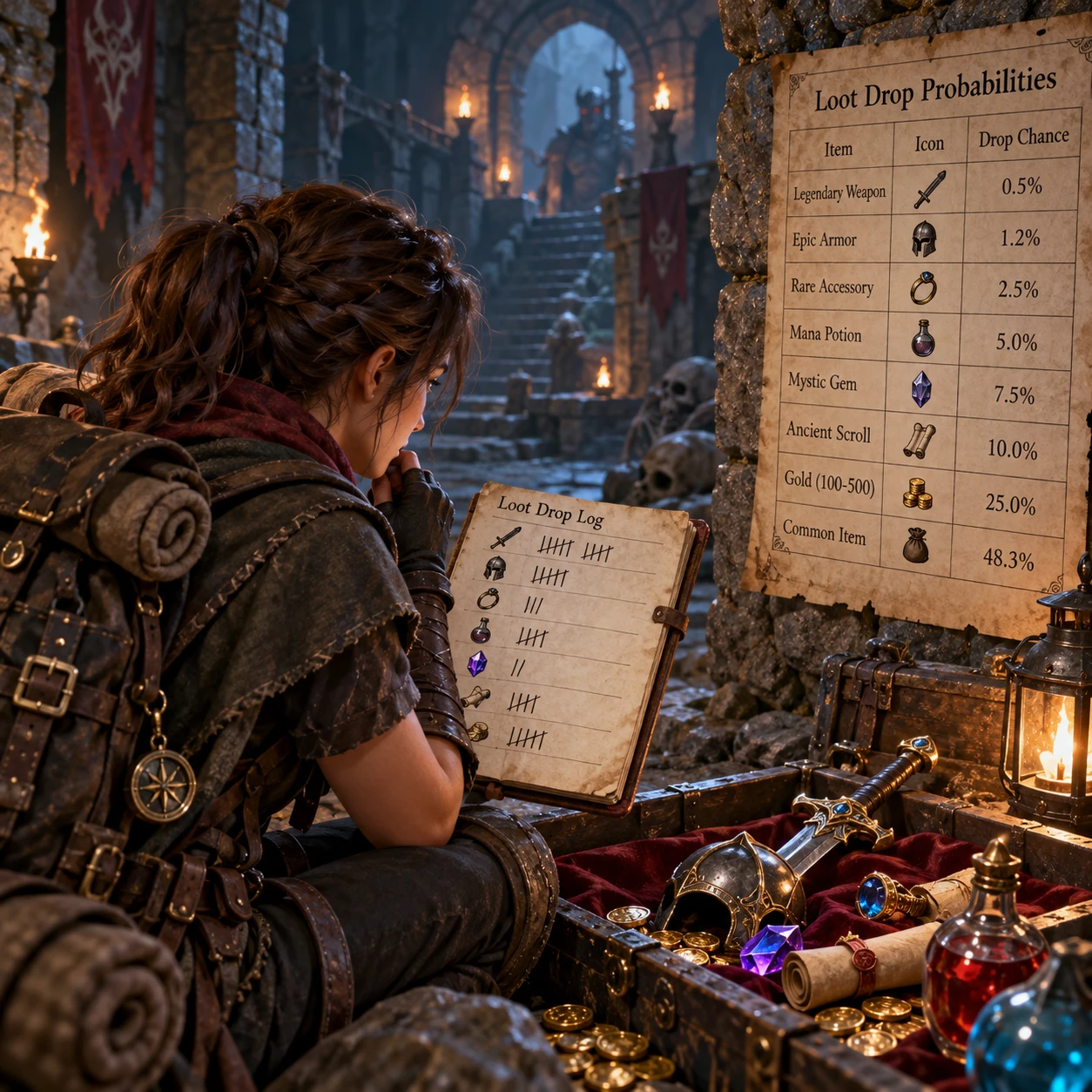
You defeat the same boss again, but the rare item still hasn’t appeared. Is the drop rate misleading, or are you having an ordinary run of bad luck? Understanding random number generation (RNG) helps explain why both outcomes are possible—and how to make farming decisions without mistaking probability for a promise.
A listed drop chance describes one attempt under specific game rules. The chance of getting at least one item across repeated attempts is a different measure, and it still does not guarantee a drop. Once you understand that distinction, you can track results, check for modifiers or pity systems, and decide whether a farming route is worth your time.
What RNG Means in Games
Random number generation (RNG) is the process a game uses to select an outcome from possible results, such as whether a defeated enemy drops an item. The game checks its rules and loot table, then uses a random value to determine the reward.
For a simple drop, imagine a virtual roll from 1 to 100: if an item has a 10% chance, a result in the relevant 10% range produces it. Actual games may use more complex systems, and a visible percentage may be affected by difficulty, player state, event rules, or other conditions. The exact implementation varies by game.
RNG can decide whether an item drops, which item appears, or how many rewards you receive. A loot table defines the possible rewards and may have several layers: first, a roll determines whether any reward drops; another roll selects its type or rarity. That means a displayed chance can refer to one stage rather than the final chance of receiving a particular item. Check the game’s descriptions or official documentation when available.
How to Read a Drop Rate
A stated drop rate is usually the probability of receiving an item on a single eligible attempt, not a schedule for when it will appear. A 5% rate means each qualifying roll has a 5% chance under the stated conditions.
For example, if a reward has a 5% chance on a boss kill, each kill is one attempt only if the game actually grants a new roll each time and you meet the eligibility rules. The percentage may apply to a particular difficulty, reward pool, or account state. If the game does not explain those conditions, treat the number as conditional rather than universal.
Repeated attempts change the chance of seeing the item at least once, but they do not change the per-attempt rate in a system with independent rolls. For a constant drop chance p across n eligible attempts, the chance of at least one drop is:
1 − (1 − p)n
At a 5% per-attempt rate, 20 independent attempts give about a 64% chance of at least one drop, not a guarantee. This cumulative probability answers a different question from the listed drop rate.
Why Repeated Attempts Don’t Guarantee a Drop
With independent attempts, every eligible roll uses the same probability, and earlier results do not make the next roll more likely. A long dry streak can happen even when the listed drop rate is accurate.
If the chance is 5%, the probability of missing the item on one attempt is 95%. The probability of missing it on 20 independent attempts is 0.9520, or about 36%. So roughly one in three players making 20 such attempts would still expect no drop, assuming the rate and independence conditions are correct.
That is why “I’ve done enough runs; it’s due” is not a reliable probability rule. RNG does not remember a player’s past failures unless the game has a mechanic that explicitly tracks them. Lucky streaks follow the same logic: several drops in a row may be unlikely, but they are possible.
Be careful with the phrase “average number of attempts.” At a 5% rate, the expected waiting time is 20 attempts, but that does not mean the item is guaranteed by attempt 20. The average describes results across many repeated trials; an individual player can get the item early, late, or not within their chosen farming period.
Loot Tables, Modifiers, and Pity Systems
Loot tables, drop-rate modifiers, and pity systems can change either the available rewards or the odds of receiving them. Their effects depend on the game’s specific rules, so a boost or guarantee should never be assumed from its name alone.
A loot table may contain mutually exclusive rewards. If an item is one of several outcomes in a rare-reward pool, its final chance can depend on both the chance of entering that pool and the item’s share within it. A displayed rate might describe the overall pool, a particular item, or a drop at a certain difficulty.
Drop-rate modifiers may include equipment, consumables, party bonuses, seasonal events, or difficulty settings. Some multiply a base chance; others add a fixed amount, affect only certain categories, or change which loot table is used. If a game states a 10% bonus, that does not automatically mean a 10-percentage-point increase. Read the game’s wording and test conditions before planning around the boost.
A pity system changes the usual independent-roll model by guaranteeing or improving a reward after specified conditions. Some systems count failed attempts, while others use milestones, tokens, or a separate currency. Confirm what resets the counter and whether the pity reward is the exact item you want. A guarantee for a rare item may still leave several possible items in the reward pool.
Tracking Drops Without Misreading the Results
To track drops accurately, record eligible attempts and relevant game conditions, then compare your results with the expected probability over a sufficiently large sample. A short log helps with farming decisions, but a small sample cannot prove that a listed drop rate is wrong.
For each run, note the date or session, enemy or activity, difficulty, whether you were eligible for the reward, active modifiers, and the result. Also record any pity counter or event state if the game uses one. Keep attempts with different conditions separate; combining boosted and unboosted runs can make the result hard to interpret.
After n attempts, calculate your observed rate as drops divided by eligible attempts. Compare it with the listed rate, but treat the difference as uncertain. For instance, seeing one drop in 10 runs gives an observed rate of 10%, yet it says little about whether the true rate is 10% or 5%. With a small sample size, chance swings are common.
- Use a spreadsheet or notes app to keep the log consistent.
- Separate attempts by difficulty, event, character, or modifier when those factors may affect eligibility.
- Track every eligible run, not only the runs that produced something.
- Use the game’s official explanations where available, and avoid treating community anecdotes as confirmed rates.
Tracking is useful for your own time and resource planning. It is less useful as proof of a hidden mechanic unless you can collect many controlled attempts and account for all possible conditions.
Using Drop-Rate Knowledge to Farm Smarter
Use drop-rate knowledge to compare the expected value of farming routes, not to predict the exact run when an item will appear. The most useful route depends on the chance per attempt, the time and resources each attempt costs, and whether the reward is actually available to you.
A simple comparison is to estimate attempts per hour and multiply by the chance per attempt. If one activity offers a 2% chance and takes two minutes per eligible run, it gives about 30 attempts per hour. Another offers a 5% chance but takes 10 minutes per run, or about six attempts per hour. Their rough expected drops per hour are 0.6 and 0.3 respectively, before accounting for travel time, failed eligibility, or other rewards. These estimates describe long-run averages, not guaranteed hourly results.
Before committing to a route, check the following:
- Eligibility: Does the target drop the item on your current difficulty or activity?
- Attempts per hour: Include queueing, travel, loading, and reset time.
- Resources: Account for consumables, repair costs, energy limits, or currencies spent per attempt.
- Modifiers and pity: Apply only bonuses or counter rules the game confirms.
- Alternative rewards: A slower route may still be worthwhile if it also yields useful materials or currency.
Expected value helps compare routes, but it cannot remove uncertainty. If a target has a low chance and every run is costly, set a time or resource limit in advance. That keeps one unlucky streak from turning a reasonable farming plan into an open-ended grind.
Frequently Asked Questions About Drop Rates
Drop-rate questions often come down to the difference between a probability and a guarantee. These answers assume the game’s listed chance is accurate and the attempts meet its eligibility rules.
Does a low drop rate mean an item is guaranteed after enough attempts?
No. With independent attempts and no pity system, each roll can still fail, even after many tries. A guarantee exists only if the game has a rule that explicitly provides one.
Why can players get very different results from the same drop?
Random variation produces different outcomes across players. One player may get an item early while another has a long dry streak, even when both face the same per-attempt chance and make the same number of eligible attempts.
Do drop-rate boosts always improve the chance of a specific item?
No. A boost may affect only certain reward categories, apply to a pool rather than a specific item, or use a calculation that differs from a simple percentage-point increase. Check the game’s rules to see what the modifier actually changes.
How many attempts are enough to judge a drop rate?
There is no universal cutoff. More attempts reduce the influence of random swings, but even a large personal sample can remain uncertain. Track conditions carefully and use official rates when available rather than treating a small sample as proof of an error.