The Psychology Behind In-Game Purchases and Microtransactions

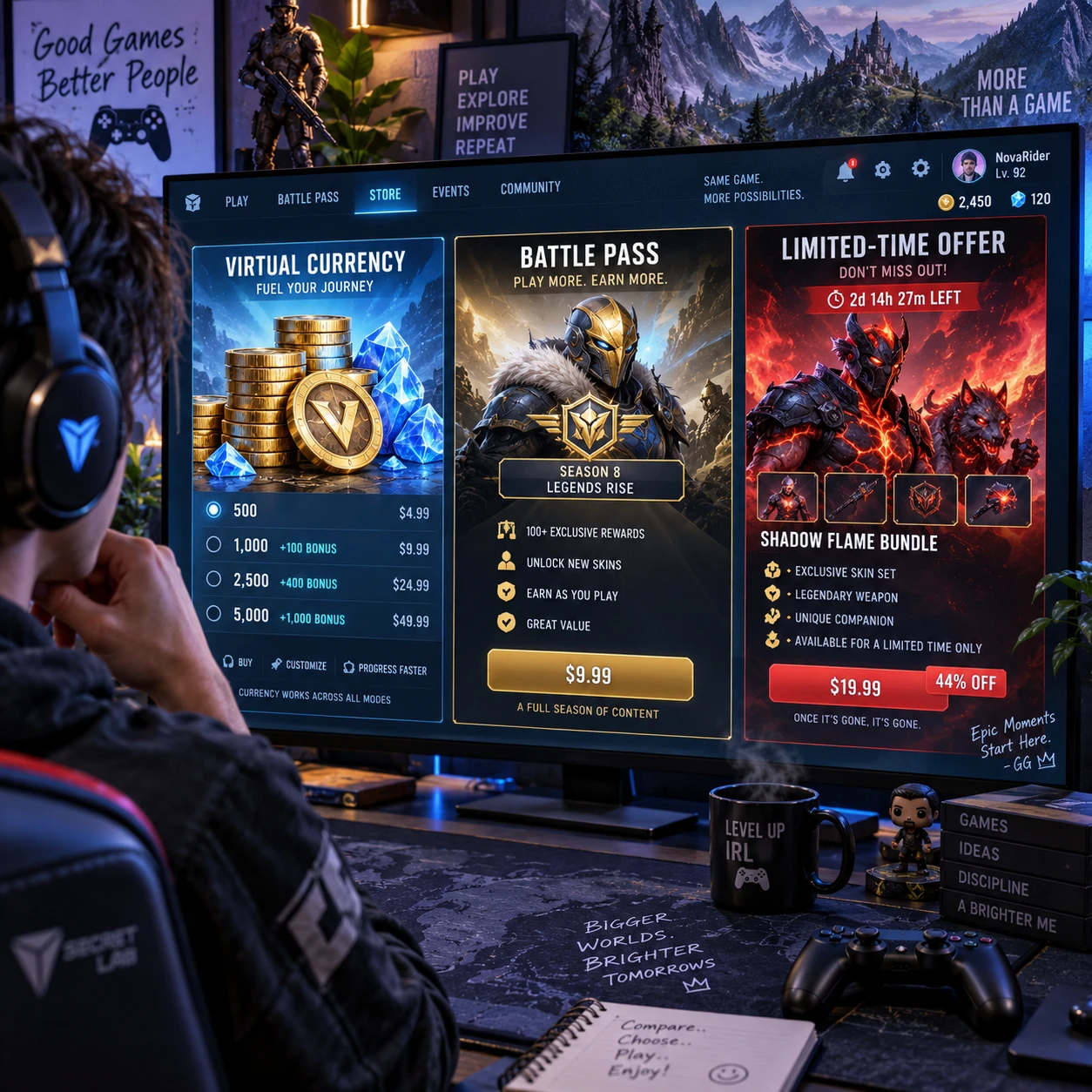
A cosmetic skin, a handful of virtual coins, or a shortcut through a slow farming loop can each seem like a small choice. In-game purchases are shaped by more than price, though: game economies, reward systems, convenience, and social context can all influence how a transaction feels in the moment.
Understanding those mechanics does not mean every purchase is harmful or every player reacts the same way. It gives players a clearer way to recognize spending triggers, weigh what an item is worth to them, and decide whether to buy.
What Counts as an In-Game Purchase?
An in-game purchase is anything bought with real money or paid virtual currency inside a game. Common types include cosmetic items, downloadable content, battle passes, loot boxes, and progression boosts, each of which plays a different role in a game’s economy.
Microtransactions are smaller or repeatable purchases, although the term can cover a wide range of prices. A free-to-play game might sell character skins, extra inventory space, or a premium currency bundle. A paid game might offer an expansion, a season pass, or optional cosmetic content.
- Cosmetics change appearance without necessarily affecting performance.
- Convenience items can reduce waiting, expand storage, or simplify a task.
- Progression boosts may provide experience, resources, or access to upgrades sooner.
- Battle passes offer rewards tied to challenges or play over a set season.
- Loot boxes or similar packs provide an uncertain item or set of items.
The distinction matters. Buying a known skin is different from paying for a chance at a rare drop, and either differs from purchasing an expansion with a defined amount of content. To understand an offer, check what it provides, whether it affects gameplay, and whether the game presents its price in dollars or virtual currency.
Why Small Purchases Can Feel Easy to Make
Small in-game purchases can feel easy because virtual currency and quick checkout make the real-money cost less immediate. When a player sees a price in gems or coins rather than dollars, converting the offer back into a budget can take extra effort.
Virtual currency adds a layer between spending and receiving an item. A player may buy a bundle of 1,000 tokens, then spend 850 on a cosmetic without pausing over its cash price. Bundles can also leave a balance that seems like a reason to return, even though that remaining currency was already paid for. The useful check is simple: What would this item cost in real money?
Low-friction checkout can contribute too. Saved payment details, a one-tap confirmation, or a purchase made during a match reduces the time available to reconsider. That convenience helps players avoid tedious steps, but it can also make repeated purchases harder to notice.
Before buying, translate virtual currency into a cash amount and look at the total spent over a week or month. For example, three small purchases may seem trivial on their own but take up a meaningful share of a discretionary budget together. A spending cap or requirement to confirm each transaction restores a pause without ruling out purchases altogether.
Rewards, Randomness, and the Pull of “One More Try”
Variable rewards are rewards whose timing or value is uncertain, and that uncertainty can make repeated attempts feel compelling. Loot boxes are a common example, though the effect varies by player, game, and context.
A player opening a pack might receive a common item, a useful upgrade, or a rare cosmetic. Because the outcome is unknown before opening, anticipation becomes part of the experience. If the desired item does not appear, a player may feel tempted to try again. That response is not inevitable, and random rewards do not affect everyone in the same way, but uncertainty can make it harder to judge the value of the next purchase.
Check whether an offer guarantees a specific item or only a chance at one. If the game publishes odds, read them; even a clearly stated low probability does not guarantee a rare result after a set number of attempts. Consider deciding in advance how much, if anything, you are willing to spend on random rewards. A fixed limit protects against raising the budget after an unsuccessful attempt.
One practical rule: compare the cost of several attempts with the price of a guaranteed alternative, if one exists. If you would only be satisfied with one specific item, a random pack may offer poor value for your goal.
Progression, Convenience, and Pay-to-Skip Choices
Purchases can change progression by saving time, supplying resources, or letting players skip part of a game’s farming loop. Whether that feels worthwhile depends on how much the player values the time saved and whether the shortcut preserves the fun they want from the game.
In a role-playing game, a boost might help a player reach a new region sooner. In a farming or crafting game, a resource pack could bypass several gathering sessions. A purchase can be convenient when someone has limited playtime, but it may also skip the activity that gives progression its meaning. The same shortcut can feel like relief to one player and like paying to avoid the game to another.
Consider what the purchase changes:
- Time: Does it reduce waiting or remove a repeated task?
- Access: Does it unlock content that would otherwise remain unavailable?
- Challenge: Does it make a difficult encounter easier, or alter competition with other players?
- Enjoyment: Will you still enjoy the game after skipping this part?
Progression systems can also create a sunk cost effect. After investing hours in a character, season, or collection, a player may feel pressure to spend more because they have already put so much into it. Past effort cannot be recovered by buying an upgrade. Judge the next purchase by its future value, not by the time or money already spent.
FOMO, Limited Offers, and Social Pressure
FOMO, or fear of missing out, can make limited-time offers feel urgent by emphasizing that an item or reward may soon disappear. Social pressure can add to that urgency when friends, teammates, or streamers are using or discussing the same content.
A countdown timer, seasonal shop rotation, or battle pass deadline gives a decision a time limit. That may help a game schedule fresh content, but it also gives players less time to compare an offer with their budget. A battle pass can feel especially pressing when its rewards require regular play: buying late in a season may leave too little time to earn the items that made it attractive.
Social context matters as well. Seeing a friend’s rare cosmetic can make it seem more desirable, while group events may encourage everyone to buy a matching item. Those purchases may genuinely add fun or a sense of participation. The key is to separate “I want this” from “I feel I need this before other people move on.”
When an offer is time-limited, pause long enough to check its full price, duration, and likely use. If you would not want it without the countdown or group pressure, let it pass. Rotating shops can bring items back, but they may not; make the decision based on what is known, not on an assumption that it will return.
How to Make More Deliberate Spending Decisions
To make more deliberate in-game spending decisions, identify the trigger, translate the price into real money, and compare the purchase with a limit you set before opening the shop. This small routine helps separate lasting value from urgency, randomness, or impulse.
Try this four-step check before purchasing:
- Name the trigger: Is the offer appealing because of its gameplay value, a countdown, a disappointing loot box result, or pressure from friends?
- Calculate the real cost: Convert virtual currency into the amount charged, including the cost of any bundle needed to afford it.
- Check your use: Will you use the item often, or does it mainly seem attractive in the shop right now?
- Apply your limit: Compare the total with your monthly entertainment budget and stop when you reach your preset cap.
Useful boundaries can be practical rather than restrictive. Turn off one-tap payments, remove saved card details, use platform spending controls, or set a monthly allowance. For battle passes, check the season length and your available playtime before buying. For a loot box, decide on a maximum beforehand and do not increase it to chase a particular result.
Review purchases periodically, too. A simple list of date, amount, and item can reveal whether spending is occasional and planned or clustered around events and limited offers. The aim is not to label every transaction good or bad. It is to make sure the purchase matches your priorities, budget, and enjoyment of the game.